Finished reading Gösta Berlings Saga
For the past couple of years, I have tried to read more Danish/Nordic books. It's a good way to stay in touch with where I come from, and a way to relax to just read Danish instead of English and Japanese all the time.
I came across a review of a book in a small series startet in 2025 or so, where Gyldendal (of course it's Gyldendal) republishes old Nordic classics in modern Danish. Great, I thought, that's my to-do list right there. However, I saw the prices and it suddenly became more of a wishlist.
I was back home in Denmark at one point after that discovery, and mentioned it to my mom. I mentioned the first book, Gösta Berlings Saga by Selma Lagerlöf (who was the first woman to win the Nobel prize in literature), and she got up and took down a copy she had on the shelf.
"Read this," she said, "and save the money". "What's next on your list?"
And as I gave her the other titles, she pulled down book after book. With only a few exceptions, all the books on the list were already present in our house. I am lucky to have grown up in such a house, and grateful that I have come of age and mind to appreciate it now. (I will not even begin to think of what I could have become, had I read more of what was present earlier on..🤦♂️)
The book itself
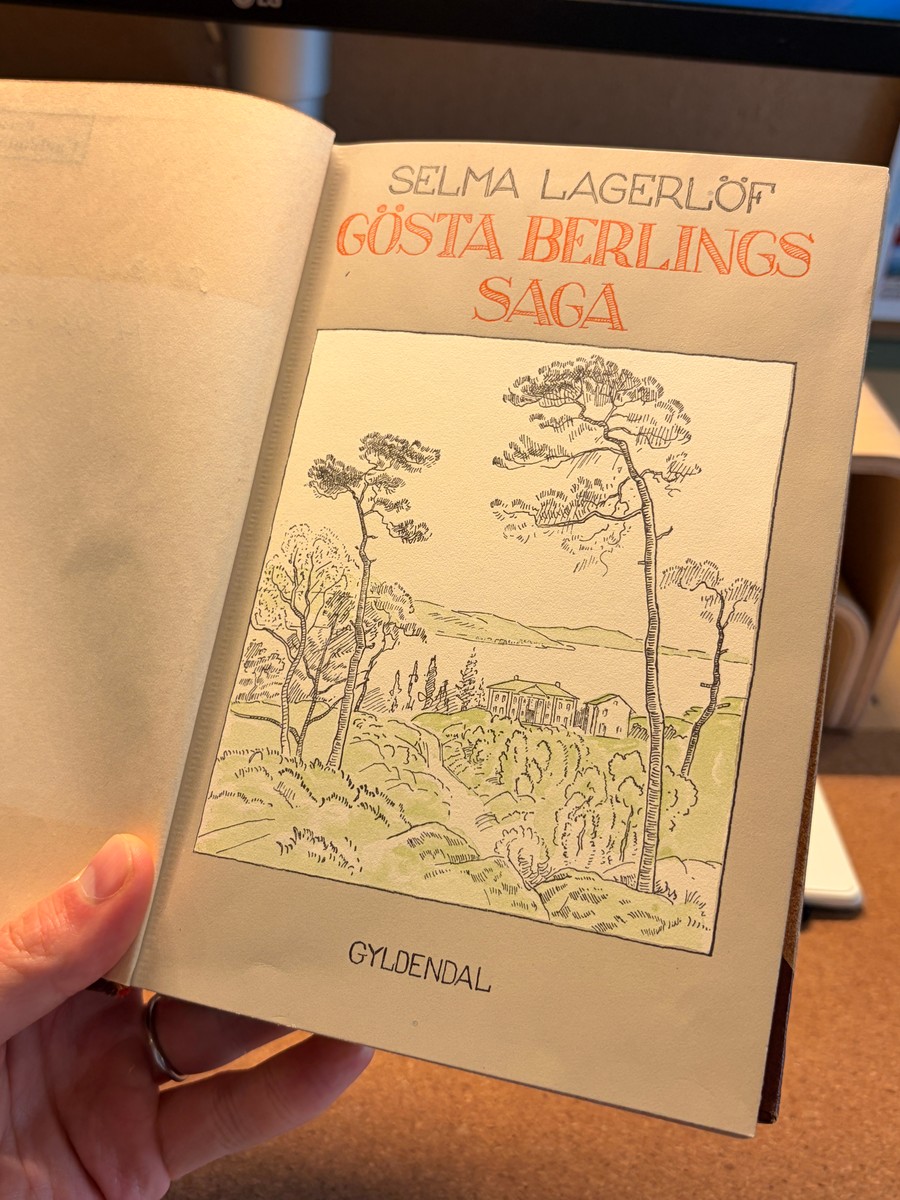
The book itself is hard cover, but I don't know if this had been done before. The title page, with a beautiful pencilled illustration, looks like it could have been on a paperback. This has been printed in the 1950s, and paperbacks become popular in the 30s and 40s.. I don't know. But it is lovely to have these kinds of books in your hands.
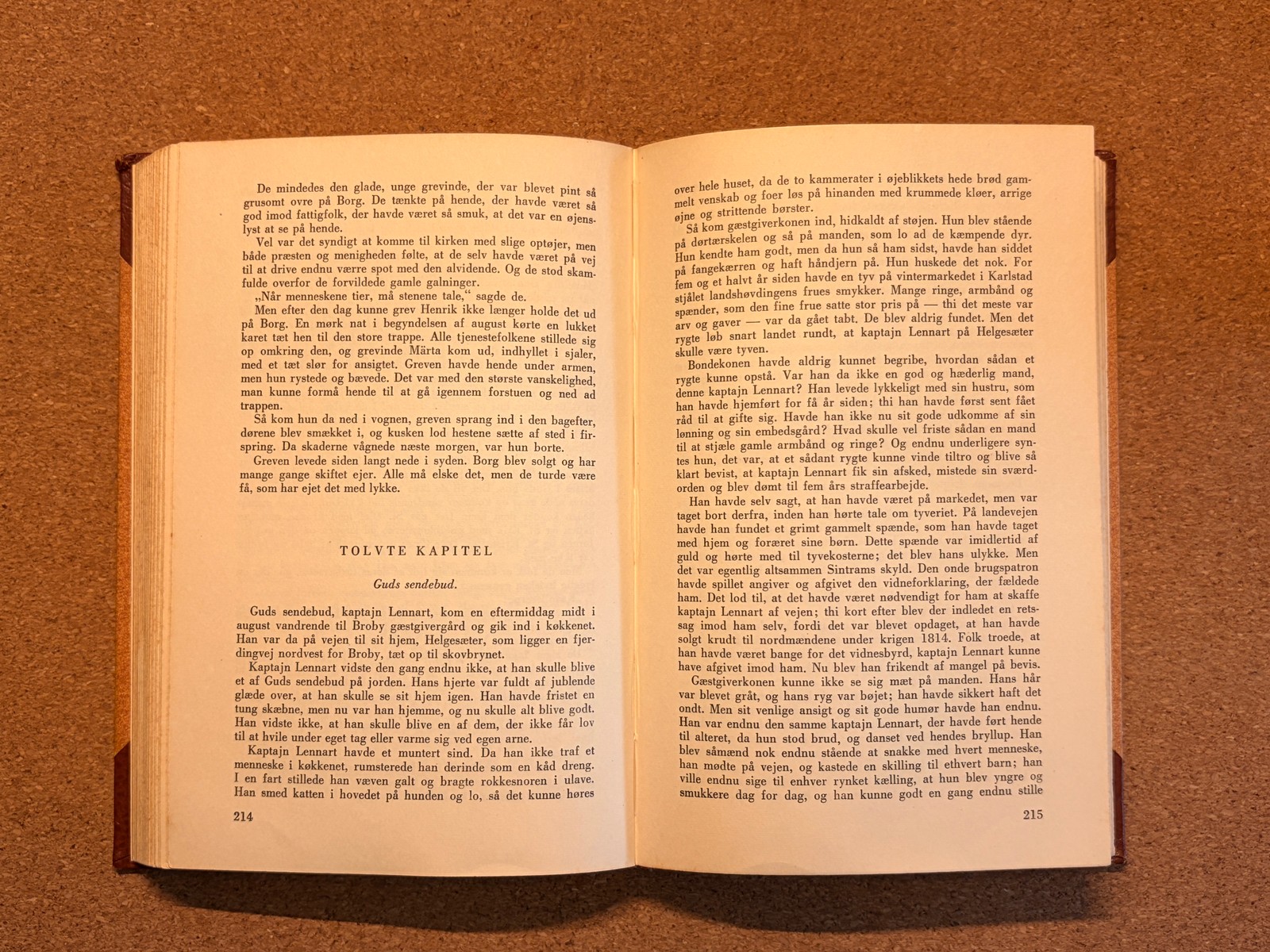
The pages are slightly yellowed, without being rottenly so. It's very easy on the eyes, rather than the sharp whiteness of many newer books.
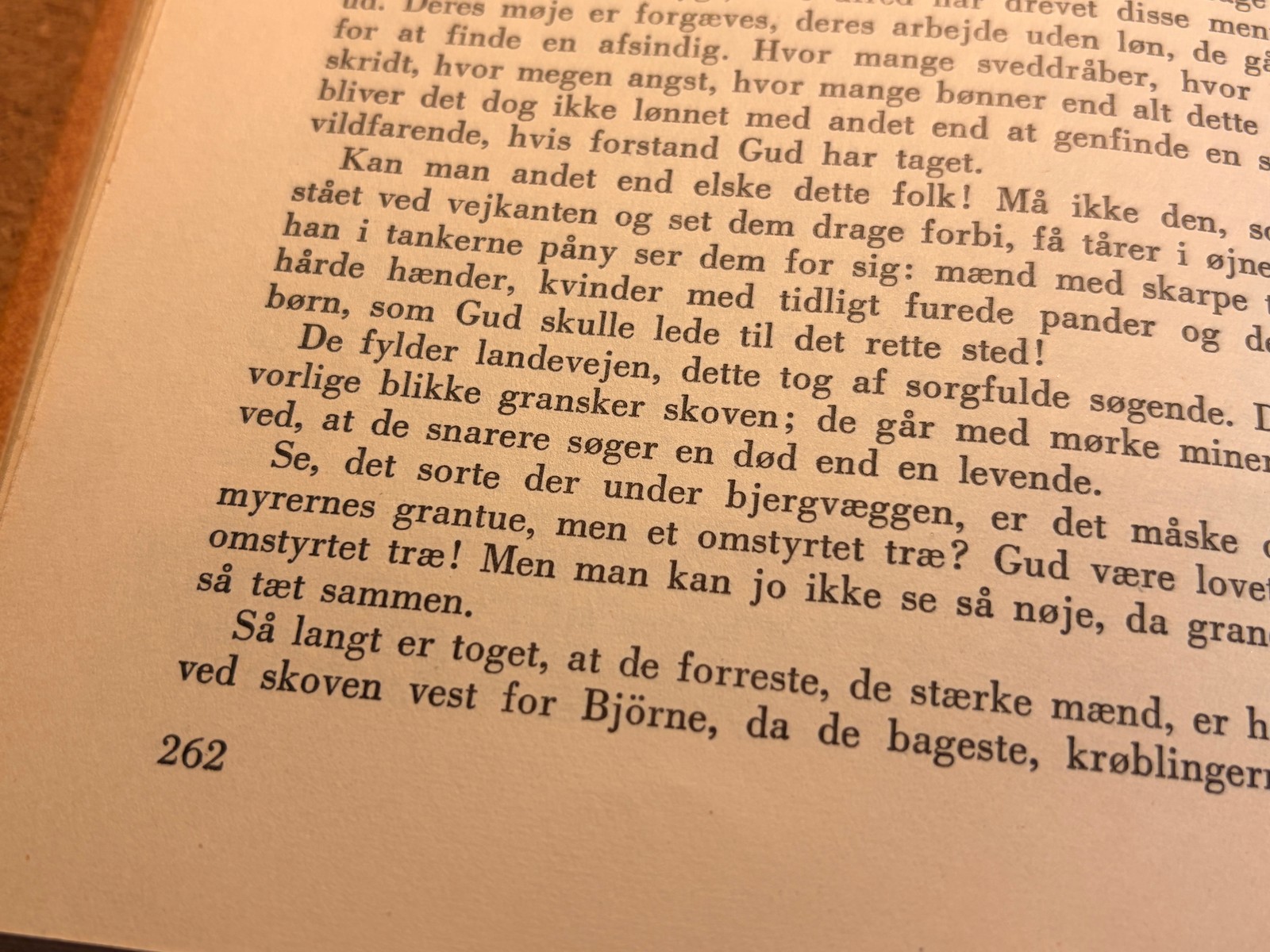
The type itself is also easy to read. No fuss. It comes off as slightly dense, which (together with the language itself) made it a bit difficult to pick up the book between reading sessions.
The printing feels delightfully tactile. I have zero idea how it happens, but in some places there was also some small anomalies. Like an 'e' falling a bit off the line. How on earth does this happen?!
The language
When it comes to Danish, I really enjoy reading stuff from the 1940s and 50s. Perhaps up to the 80s, even. From then, things begin to fall apart, and moving into the 2000s, we've totally capitulated the Danish language and introduced so many Anglifications, that it becomes a weird pidgin language. To write (and speak!) in Anglifications, is a way to not only give up the nuances that we can express, but we also subordinate ourselves to the torrents from the US (social) media. All people can do now is wait to see what's next online, and then regurgitate that. Add to this a diminished and more simplistic vocabulary overall, and we're looking (and sounding) quite bad. AI of course exacerbates this trend.
The story
I'll start with a confession. I had read maybe a third of the book, maybe less, and I felt it was quite incomprehensible. Small stories were scattered on the pages, with characters going in and out. The timeline felt stuttering, and I just couldn't really grapple with what was being told.
So I did a Google search on "how to read Gösta Berlings Saga". Some high school Danish teacher must have made a reading guide for 17 year olds, I thought. And indeed, some professor whatever had actually made a blog post about how to approach the book. The basic message was this: don't worry about grasping the whole, just enjoy the small vignettes as they come along. Hang in there, basically, and enjoy the ride.
This gave me the confidence to proceed, and I was much more relaxed in doing so. Enjoying descriptions and images, instead of feeling dumb for feeling like I missed a plotpoint.
So what is it about? Well, it is about this guy, Gösta Berling, who is this blonde hero figure. He was a priest, but got ousted for drinking. He wanted to commit suicide, but got saved by the forceful lady in a huge and wealthy farming enterprise.
He joins the gang of "Cavaliers" (?) on the farm, which seems like a long-gone institution. Men who have been traumatized or lost their job, lost their way, can stay at wealthy farms for free, but help by contributing the (liberal arts) skills they have.
Then it's just a series of ups and downs. Superstition, encounters with the devil and his helpers, betrayal, love, death..
I can't remember half of it, or either many of the names, but the writing is so good, and the stories so poignant, that I feel that something of depth and value has stayed with me.
There's a lot of affection for Nature, and for community. For caring and helping. There's forgiveness, and the rewards that honesty brings.
Some scenes almost made me cry, some made me laugh and some I had to reread and write down in a notebook, to take with me going forward.
Here's two things I have written in my notebook:
Death, the liberator
My pale friend, the liberator, came in August, when the nights were pale with moonlight, to Captain Uggla's farm. But He didn't dare go straight into this hospitable home; for few are they, who love him. --- My pale friend, Death, the liberator, has a brave heart. It is His pleasure to ride through the air, carried by glowing cannonballs. He swings around His neck, the whistling grenade and laughs, as it explodes with shrapnel flying all around. He swings about in the ghostly dance in the cementaries, and doesn't shy away from the plague wards in the hospitals, but He shivers at the doors of the lighthearted, in the chambers of the good. For He does not want to be greeted by tears, but rather with quiet relief, He, who liberates the spirits from the chains of pain, who liberates them from the heavy dust and let them taste the free and magnificent life in the universe. (Universe here is my translation of "verdensrummet", which is World Room or Space.. I feel it carries more spiritual meaning than the physical "Universe" alone, but couldn't come up with a better word)
I feel the Death as liberator is a profound way of thinking of it, and she adds the beautiful nuance between Good and Bad.
"I am no longer longing (for my place of birth, -red.), madame Major. My husband has solved the riddle, and found the life I can live."
This is taken out of lot a context, but basically I like the feeling that is conveyed of life being a riddle to solve, before we can settle in. People around me are growing into their 30s and 40s, and the conversations I'm having are feel akin to grappling with a riddle.
I wont tell you HOW her husband solved the riddle, or even what it is, but as I turned the final page, I felt like I understood it better, even as I didn't really understand the first half of the book.
I'll read it again for sure, and I highly recommend that you read it too. It's probably available in most languages by now.